
Property Development
Alyssa Castillo
Artificial intelligence is finding its way into construction businesses, but there is a considerable difference between using AI to write a project update and trusting it to help manage a live development. Property developers deal with changing budgets, outstanding approvals, procurement deadlines and decisions that can affect millions of pounds. An AI tool that understands language but has no access to those operations can only offer limited assistance.
This is the problem Morta is addressing with ATROM, its specialist agentic AI for property developers. Built directly into Morta's property development software, ATROM works with live project information to carry out operational tasks, prepare reports, monitor outstanding actions and assist teams throughout the development lifecycle. Rather than requiring developers to explain their entire business to a general-purpose chatbot, ATROM operates within the platform where their projects are already managed.
AI for construction refers to artificial intelligence technologies used to support the planning, management and delivery of construction projects. Applications range from analysing project documents and estimating costs to monitoring programmes, identifying risks and automating administrative work.
For property developers, the potential extends beyond construction activity itself. A development begins long before a contractor arrives on site, with land acquisition, feasibility studies, financial appraisals and procurement. Once construction begins, developers must oversee commercial performance, consultants, contractors and contractual obligations before eventually managing handover.
Consequently, useful construction AI must understand how decisions across these activities affect the development as a whole. According to the Royal Institution of Chartered Surveyors' 2025 AI in Construction report, based on responses from more than 2,200 professionals worldwide, approximately 45% reported no AI implementation within their organisations, while another 34% were still in early pilot phases. The figures suggest that although the industry recognises AI's potential, many businesses have yet to establish how to use it consistently within everyday operations.

General-purpose AI tools such as ChatGPT can be useful for drafting correspondence, summarising information and explaining unfamiliar construction terminology. However, their usefulness depends heavily on the information supplied and the systems they can access. Consider a developer overseeing five active projects who wants to know which developments are at risk of exceeding their approved budgets.
A conventional chatbot without access to the company's systems cannot reliably answer that question. Someone would first need to gather the latest cost reports, commitments, variations and forecasts from each project. Even then, the AI could only analyse the information provided, which may already be outdated. Furthermore, a generated recommendation does not automatically update the relevant project records or initiate the next approval.
Agentic AI addresses a different requirement: the ability to use information, reason through a task and take permitted actions within connected systems.
For example, instead of simply explaining how to prepare a construction programme, an agentic system can be designed to create programme activities, establish dependencies and organise milestones using available project information. Nevertheless, these capabilities depend on the software's integrations, permissions and available data. Agentic AI should never be assumed to have unrestricted authority over financial or contractual decisions.
For property developers, the distinction matters because project management involves continuous action, rather than occasional requests for information.
ATROM is Morta's all-in-one, end-to-end AI assistant, designed around the operational requirements of property developers, project management consultants and development teams. It works through a conversational interface, allowing users to request actions in ordinary language. Behind that interface, specialist AI agents support activities involving project operations, commercial management, finance, development, documentation and reporting.
Importantly, ATROM works within Morta's existing project environment. This gives it a practical advantage over a standalone chatbot that has no direct connection to a developer's operational records.
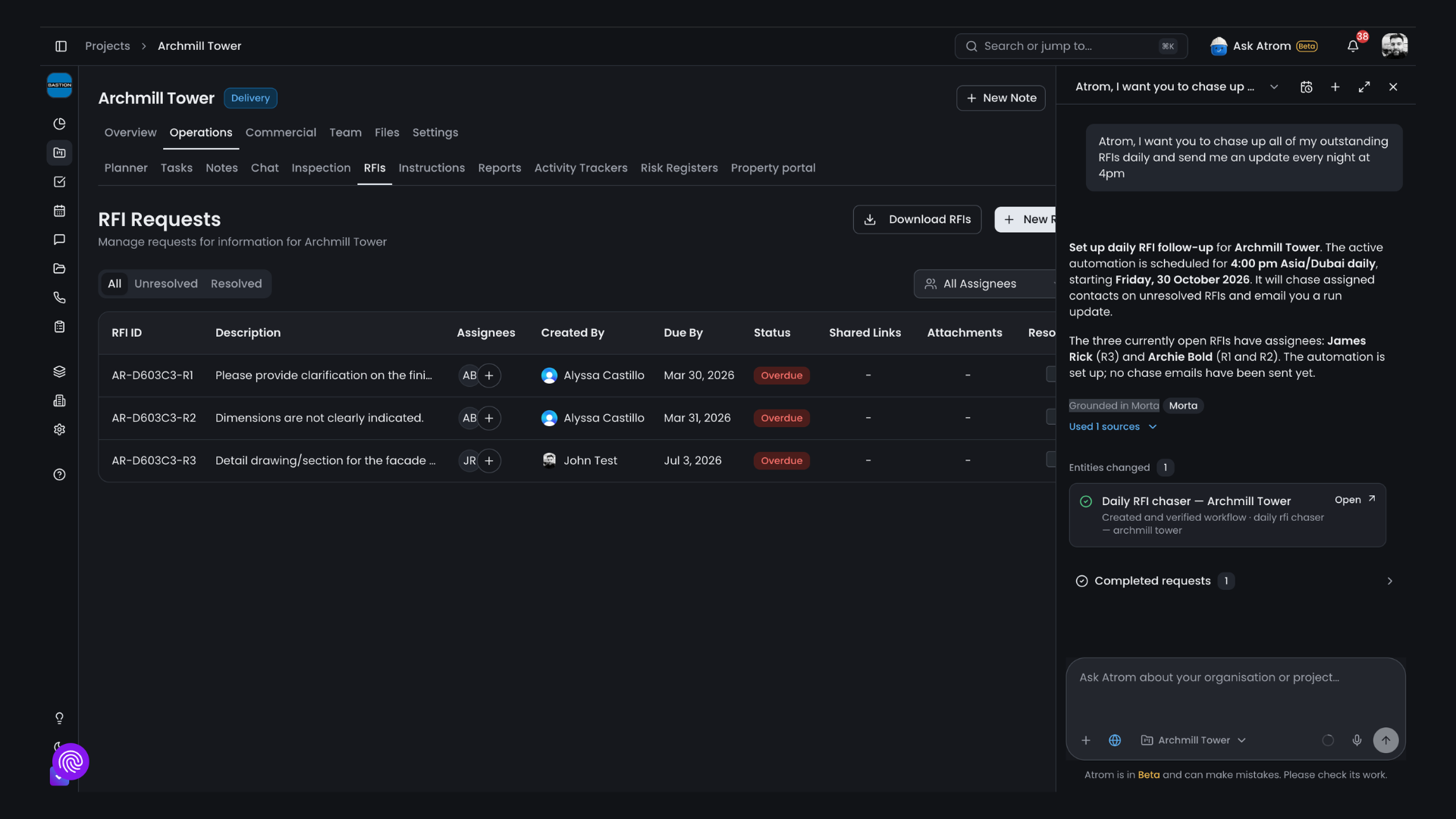
A developer might ask ATROM to identify overdue requests for information, review outstanding approvals or prepare a summary of commercial risks across a portfolio. Instead of manually reviewing several project areas, the user can request the relevant information through one interface. ATROM can also assist with tasks that would otherwise involve extensive preparation. For instance, it can generate detailed project programmes, establish dependencies between activities and help prepare cash flow forecasts using programme and budget information.
The objective is to reduce the administrative work required to manage a development while keeping project teams responsible for reviewing decisions and approving consequential actions.
Suppose a developer is preparing for a monthly board meeting. The commercial team has updated project costs, the project manager has revised the programme, and several procurement packages are awaiting approval. Ordinarily, someone must gather these updates, reconcile the information and prepare a report that explains the project's current position.
With ATROM, the developer can request a project briefing using information held within Morta. The AI can assist in bringing together relevant project data, highlighting outstanding actions and preparing material for review. If the developer subsequently asks which approvals are delaying procurement, ATROM can help identify the relevant outstanding items. Where an action is permitted, it can assist with the next operational step, subject to the applicable approval workflow.
This approach is particularly relevant to corporate developers managing several schemes simultaneously. However, independent developers can benefit as well, especially when administrative responsibilities fall on a relatively small team.
One of the persistent difficulties in development management is obtaining an accurate picture of project performance without waiting for the next reporting cycle. Financial information may sit with the quantity surveyor, programme updates with the project manager and procurement records with another team. Even when each party maintains accurate records, compiling them into a useful management report takes time.
AI-assisted construction reporting can reduce that preparation work by drawing on information already available within a connected platform. For example, ATROM can help developers prepare project briefings, examine outstanding actions and review information across their portfolio. The benefit is particularly relevant when decisions cannot wait until the next scheduled meeting. A developer considering a new acquisition may need to understand existing financial commitments before allocating additional capital.
However, reporting quality still depends on the accuracy of the underlying records. AI can accelerate the interpretation of project information, but it cannot make incomplete or incorrect data reliable.
Construction cost tracking software helps developers monitor approved budgets, commitments, variations, payments and forecast expenditure. Yet recording these figures is only part of effective commercial management. Developers must also understand why costs are changing and whether those changes require intervention.
Within Morta, ATROM can assist users in examining project financial information and preparing commercial summaries. It can also support budget-related workflows while respecting the relevant approval requirements. This allows commercial teams to spend more time evaluating financial decisions and less time assembling information for those decisions.
Procurement delays can have consequences well beyond the package being purchased. A late tender decision may affect contractor mobilisation, subsequent programme activities and eventually the development's completion date. For developers managing multiple consultants and suppliers, maintaining visibility over these dependencies can become demanding.
ATROM can support tender preparation, identify outstanding procurement actions and assist with follow-ups. Combined with Morta's procurement and supplier management capabilities, this creates opportunities to reduce repetitive coordination work. Although construction supply chain management software typically focuses on supplier and procurement processes, developers also need to understand the financial and programme implications of those activities.
That broader perspective is particularly important when procurement decisions affect the commercial viability of an entire scheme.
Allowing AI to execute operational tasks introduces responsibilities that do not arise when using it simply to draft text.
A financial approval, for example, may involve contractual obligations and authority limits. An AI system should not be able to bypass those controls merely because someone has requested an action.
ATROM is designed to operate within Morta's existing user permissions and approval workflows, with actions subject to governance and audit trails. Users retain responsibility for decisions requiring authorisation.
This approach is consistent with the principles outlined in the US National Institute of Standards and Technology's AI Risk Management Framework, which emphasises accountability, transparency and the management of risks associated with AI systems.
For developers evaluating construction AI, these considerations should be part of the purchasing decision. The ability to automate a process is valuable, but understanding who authorised an action and how it was recorded is equally important.
The case for adopting AI is becoming increasingly practical.
RICS identified a lack of skilled personnel, integration difficulties and poor data quality among the leading barriers to construction AI adoption in its 2025 industry research. These findings highlight why purchasing an AI subscription alone is unlikely to transform a development business.
Organisations need systems that make project information accessible, establish consistent workflows and allow teams to introduce automation responsibly. For an independent developer, this could mean reducing the hours spent preparing reports and chasing outstanding information. For a corporate developer, the opportunity may involve improving oversight across a substantial portfolio without proportionately increasing administrative resources.
The important consideration is where AI can produce measurable operational improvements. Developers should assess the time required to complete existing processes, the reliability of project information and the extent to which automation improves decision-making. Adoption does not need to begin with every department. A clearly defined reporting or procurement workflow can provide a useful starting point before introducing AI into more complex activities.
AI adoption will increasingly influence how property developers organise information, coordinate teams and manage commercial decisions. However, the greatest benefits are likely to come from applying the technology to real operational requirements rather than adopting it simply because it is available.
ATROM brings this approach into Morta, combining specialist agentic AI with a platform designed around the property development lifecycle. Developers can use it to support reporting, programme preparation, commercial management and routine project coordination while retaining oversight of important decisions.
For developers interested in understanding how AI could work within their own projects, the next step is to examine the processes that currently consume the most time.
Discover how ATROM can support your property development operations. Book a discovery call today with Morta and explore what agentic AI could do for your business.