Property Development
Should You Get AI for Property Development for Your Next Project?
Alyssa Castillo
Alyssa Castillo
Property development has never been short on opinions. Everyone has a spreadsheet template, a WhatsApp group, and a preferred way of doing things. What has changed in the last few years is not the ambition of developers, but the volume of information they are expected to manage.
Costs shift weekly. Regulations tighten. Programmes move. Contractors change. Buyers expect higher quality and faster delivery.
For developers who are learning property development for the first time, this complexity can feel overwhelming. For experienced developers, it often feels like there is more admin than actual decision making.
This is where the conversation around AI for property development starts to make sense. Not as a trend, not as a replacement for experience, but as a way to reduce friction across real projects.
The real question is not whether AI exists in property development. It already does. The question is whether you should actively use it on your next project.
Try Morta for Free
AI in property development is often misunderstood. It is not about handing decisions to a black box or letting software run your business. In practice, AI tools for real estate developers are designed to support analysis, automate repetitive work, surface risks earlier, and help teams make better informed decisions.
McKinsey has reported that companies adopting AI across operations can see productivity improvements of up to 40 percent in specific workflows.
In property development, those workflows tend to sit around planning, cost control, documentation, forecasting, and communication. These are areas where developers spend hours reviewing information rather than acting on it.
For a long time, property development software focused on storage rather than insight. Systems collected data but rarely helped developers interpret it. AI changes that relationship.
According to Deloitte, organisations using AI driven analytics are significantly faster at identifying risks and responding to change. For property developers, this translates into earlier visibility of cost overruns, programme risks, and coordination issues.
AI is not equally useful everywhere. Its value shows up most clearly in specific parts of the development lifecycle.
Early stage planning sets the tone for the entire project. Small assumptions made during feasibility can have long term consequences.
AI for property developers helps by analysing historical project data, comparable schemes, and market inputs to support more informed feasibility assessments. This does not remove the need for experience, but it reduces blind spots.
Developers using AI supported planning tools can stress test assumptions faster and explore more scenarios without manually rebuilding models.
This is particularly useful for developers involved in property flipping, where speed and accuracy directly affect returns.
Cost control is one of the most stressful parts of property development. Prices fluctuate. Variations creep in. Spreadsheets struggle to keep up.
AI tools for real estate developers can identify patterns in cost data, flag anomalies, and forecast potential overruns before they become critical. This kind of early warning is difficult to achieve manually, especially across multiple live projects.
The World Economic Forum highlights that AI driven forecasting improves accuracy in capital intensive industries by analysing trends humans often miss.
For property developers, this means fewer surprises and more confidence when speaking to funders and stakeholders.

Much of a developer’s time is not spent making strategic decisions. It is spent chasing updates, reviewing documents, and repeating the same actions across projects.
AI driven automation reduces this burden. Tasks such as updating records, summarising information, and responding to routine queries can be handled by systems designed for property development workflows.
This is where Morta AI begins to feel less like technology and more like infrastructure. By automating repetitive tasks within a property development platform, developers spend less time maintaining systems and more time managing outcomes.
Property development decisions are only as good as the information behind them. AI supported appraisals help developers analyse market data, historical performance, and project inputs in a more consistent way.
Rather than relying on static models, AI allows appraisals to evolve as new data comes in. This is especially valuable in uncertain markets, where assumptions need regular adjustment.
Harvard Business Review notes that AI driven decision support improves consistency and reduces cognitive bias in complex environments. In property development, this consistency can be the difference between disciplined growth and reactive decisions.
One of the most practical applications of AI for property developers is the use of assistants. These tools act as an interface between the developer and their data.
Instead of digging through systems, developers can ask questions and receive structured answers based on live project information. This changes how quickly teams can access insights.
Within Morta property development software, the assistant function allows developers to interact with planning data, costs, and project information without breaking focus. It reduces friction without introducing new processes.
Try Morta for Free
AI is not useful in isolation. Its value depends on how well it integrates with the rest of the development workflow.
Standalone AI tools often fail because they require developers to duplicate data or change how they work. The best software for property developers embeds AI into existing processes rather than layering it on top.
This is where property development software like Morta stands out quietly. AI sits alongside project planning, CRM, collaboration, and post handover processes. It does not require developers to think about stages or systems. It works in the background, supporting decisions where they already happen.
For teams already using Morta CRM or Morta construction tools, AI becomes an extension of familiar workflows rather than another platform to manage.
Despite the benefits, many developers remain sceptical. This scepticism is healthy. AI should be questioned, not blindly adopted.
The most common concerns fall into three areas.
Loss of control. AI does not make decisions independently in property development software. It supports the developer, not replaces them.
Complexity. Modern AI tools are designed to reduce complexity, not add to it. When embedded properly, they simplify workflows.
Trust in data. AI is only as good as the data it works with. This is why integrated platforms matter. Clean, structured data produces reliable insights.
Property developers who approach AI as a support tool rather than a solution in itself tend to see the strongest results.
For those learning property development, AI can act as a safety net. It helps surface risks, highlight inconsistencies, and provide context that might otherwise take years to develop.
This does not shortcut experience, but it accelerates learning. It allows newer developers to make informed decisions earlier and avoid common mistakes.
In this sense, AI becomes part of the education process, not just an operational tool.
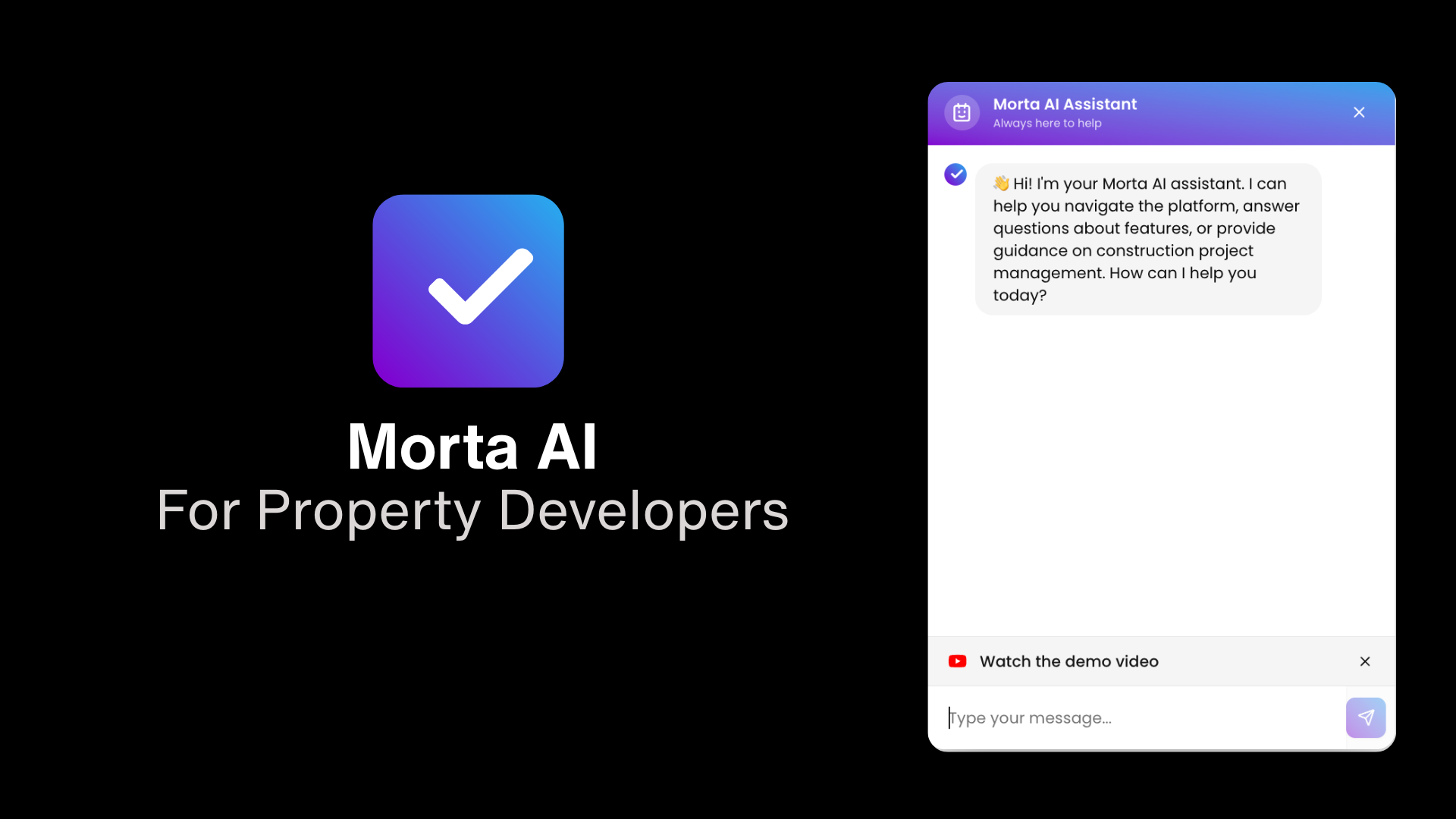
Morta does not position AI as a headline feature. It positions it as part of a broader system built for property developers.
Morta AI supports planning, automation, appraisals, and decision making within a single environment. It is designed for developers who want clarity, not complexity.
By integrating AI into property development software rather than offering it as a separate tool, Morta allows developers to benefit from AI without changing how they work.
For developers already using Morta property development tools, AI feels like a natural evolution rather than a disruption.
If your next project involves multiple stakeholders, tight margins, or compressed timelines, the answer is increasingly yes.
AI for property developers is not about predicting the future. It is about seeing the present more clearly.
Developers who adopt AI supported tools earlier tend to spend less time reacting and more time planning. They gain visibility, reduce admin, and make decisions with greater confidence.
Whether you are involved in property flipping, managing a growing portfolio, or learning property development from the ground up, AI can support better outcomes when used intentionally.
The developers who benefit most are not those chasing trends. They are the ones quietly building systems that scale with them.
And that is where AI, when embedded properly within software for property developers, earns its place.
Try Morta for free today.
Try Morta for Free