Top 5 Accounting Software for Property Developers (2026)
Alyssa Castillo
Top 5 Accounting Software for Property Developers (2026)
If you speak to any experienced developer, the conversation around profit rarely starts with sales. It starts with control. Control over costs, over timelines, over decisions that quietly shape the outcome of a scheme months before a single unit is sold.
Accounting sits at the centre of that control. Not as a back-office function, but as a live view of whether a project still makes sense.
The problem is that most tools marketed as “accounting software for property developers” were not built for development in the first place. They track numbers after the fact. They rarely help you make decisions while a project is still fluid.
That gap matters more in 2026 than it did even a few years ago. Margins are tighter, financing is more selective, and relying on static spreadsheets is becoming harder to justify when decisions need to happen quickly.
This guide breaks down five of the most relevant platforms available today, including tools that go beyond traditional accounting and into full property development software. The goal is simple. Help you choose a system that does not just record your numbers, but actively improves them.
Why accounting software for property developers needs to be different
Before looking at specific tools, it is worth clarifying what “good” actually looks like in this space.
Property development is not a standard business model. Cash flow is uneven. Costs evolve constantly. A decision made during land acquisition can quietly affect profitability two years later.
Traditional accounting tools struggle with this because they are designed for linear businesses. They assume clean inputs and predictable outputs.
Developers do not operate like that.
What tends to work better is a system that connects financial data with the actual lifecycle of a project. That means linking appraisals, budgets, contractor payments, and delivery progress into one place.
When that connection exists, accounting becomes something you use daily, not something you review at the end of the quarter.
Choosing accounting software is not about ticking features. It is about how quickly you can answer questions like:
Is this site still viable at current build costs?
What is my exposure across all live projects?
Where are we overspending before it becomes a problem?
The tools below approach this in different ways. Some focus on bookkeeping. Others move closer to full property development software, where finance sits inside a broader system.
There is a reason more developers are moving away from disconnected tools and towards platforms like Morta.com.
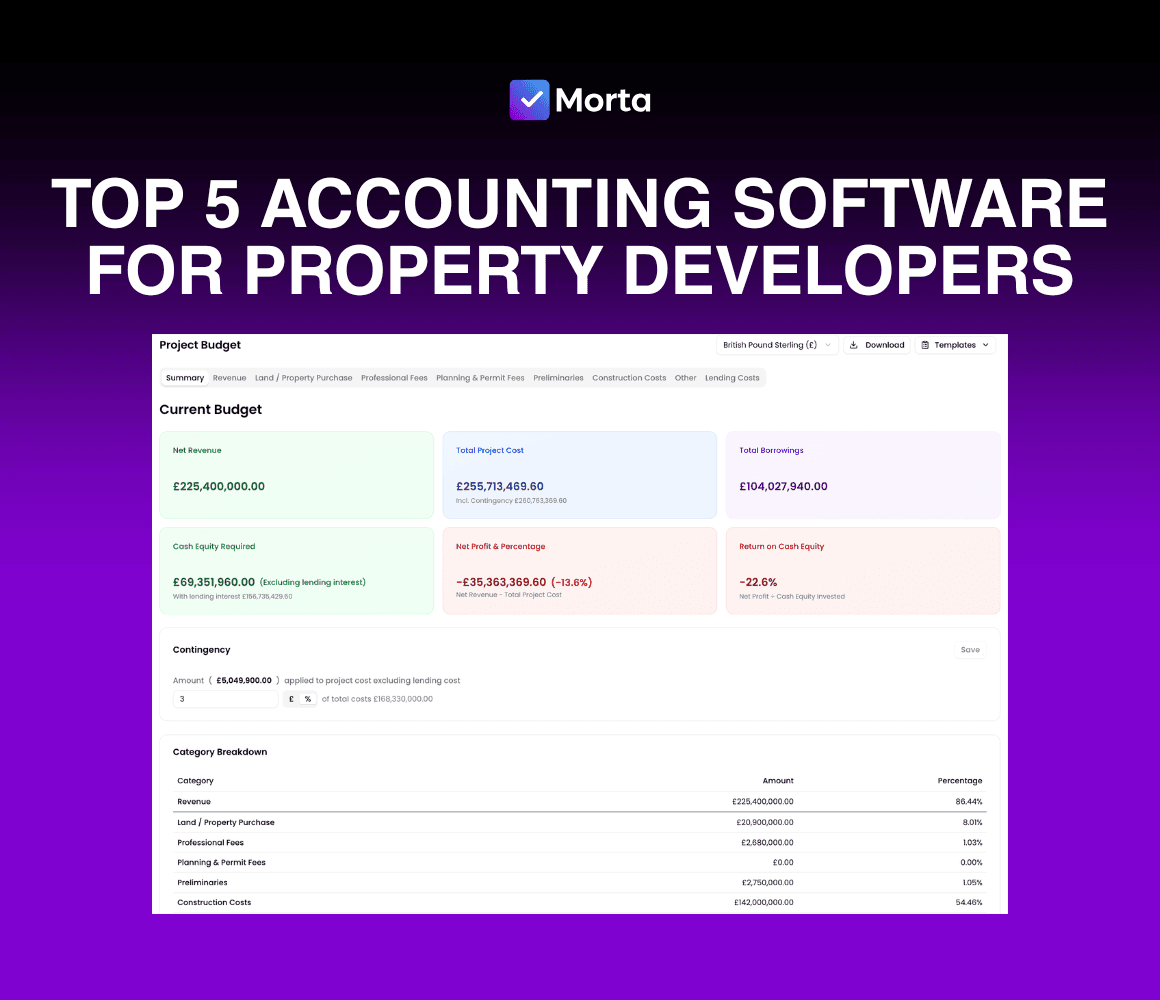
Morta is not just accounting software. It is a system designed specifically for property developers, where financial data is tied directly to how projects are actually run.
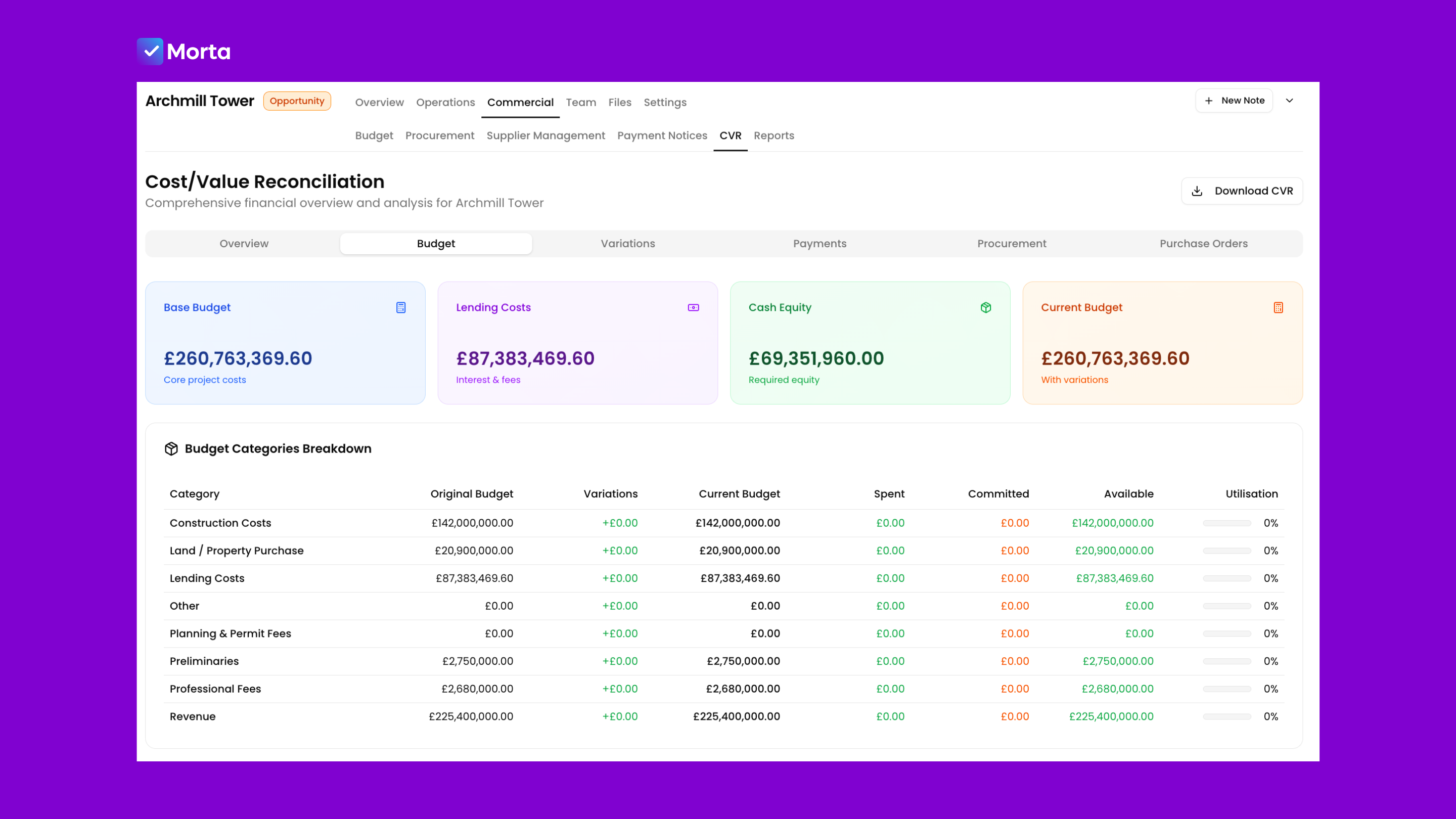
Instead of treating accounting as a separate function, Morta connects appraisals, cost planning, delivery, and reporting into one environment. That shift changes how decisions are made.
At the early stage, developers can model feasibility using live data rather than static assumptions. During delivery, budgets are not just tracked but continuously updated based on real activity. Post-handover, financial visibility remains intact rather than being fragmented across tools.
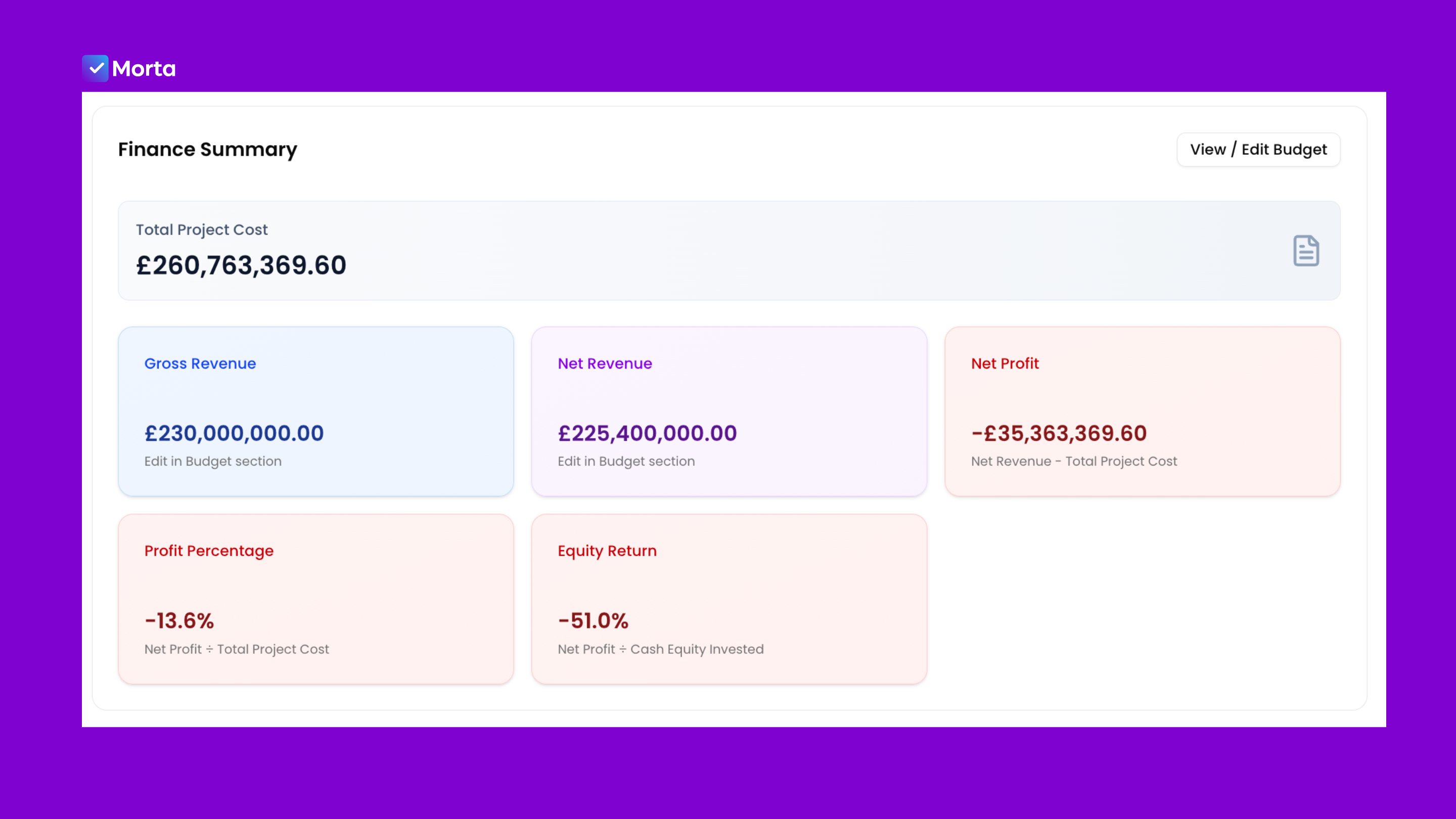
The difference is subtle at first, but significant over time. You are not waiting for reports to understand performance. You can see it as it happens.
What also stands out is the integration of property development AI. Rather than adding AI as a separate feature, it sits within the workflow. Developers can connect site appraisals with live project data, making faster acquisition decisions without relying on multiple spreadsheets.
For teams managing multiple projects, this becomes particularly valuable. Instead of jumping between accounting software, project management tools, and reporting dashboards, everything sits within a single platform.
It is worth noting that Morta is not trying to replicate traditional accounting tools. It replaces the need for several of them by acting as both a system of record and a system of control.
For developers who want a clearer view of their pipeline and tighter control over margins, Morta software is one of the most relevant options in 2026.
Xero remains one of the most widely used accounting platforms globally, and for good reason.
It is clean, easy to use, and handles core accounting functions reliably. For developers running smaller operations or early-stage projects, it can provide a solid foundation.
Where Xero performs well is in day-to-day bookkeeping. Expense tracking, invoicing, and bank reconciliation are straightforward. The ecosystem of integrations also makes it flexible.
However, its limitations become clear as projects grow more complex.
Xero was not built specifically for property development. It does not inherently understand development appraisals, phased budgets, or project-level profitability in the way developers need.
This means teams often rely on additional spreadsheets or external tools to bridge the gap.
For some, that is acceptable. For others, especially those scaling their portfolios, it introduces friction.
Xero works best when paired with a broader system. On its own, it is more of a financial ledger than a decision-making tool.
3. QuickBooks
QuickBooks sits in a similar category to Xero but with a slightly different user base and approach.
It is widely adopted, particularly among businesses that want robust accounting without too much complexity. Reporting is one of its stronger areas, offering clear financial summaries that are easy to interpret.
For developers, QuickBooks can handle core financial management effectively. It supports tracking income and expenses across projects, which is useful at a basic level.
The challenge, again, is depth.
Property development involves layers of financial nuance that standard accounting tools do not fully capture. Land acquisition costs, staged payments, contractor variations, and shifting timelines all need to be reflected accurately.
QuickBooks can record these, but it does not inherently structure them around the lifecycle of a development.
As a result, developers often end up adapting the software rather than the software adapting to them.
It is a reliable option, but not a specialised one.
4. Sage (Sage 50 and Sage Intacct)
Sage has long been associated with more advanced accounting environments, particularly for larger organisations.
For property developers operating at scale, Sage offers a level of depth that smaller tools may lack. It supports complex financial structures, multi-entity management, and detailed reporting.
Sage Intacct, in particular, is positioned as a cloud-based solution with strong financial controls and visibility.
The advantage here is precision. Larger developers with multiple entities and more intricate financial requirements may find Sage better suited to their needs than simpler tools.
The trade-off is usability.
Sage is not always intuitive, and implementation can take time. It also does not inherently solve the disconnect between accounting and project delivery.
Even at this level, developers may still rely on separate systems for managing projects, contractors, and appraisals.
This is where the distinction between accounting software and property development software becomes more apparent.
5. Buildxact
Buildxact takes a slightly different approach by focusing more on construction and estimating, while still offering financial tracking capabilities.
For developers involved closely in the build process, this can be useful. Cost estimation, quoting, and project tracking are integrated into the platform.
It is particularly popular among builders and smaller development teams who want a tool that bridges construction and finance.
However, Buildxact leans more towards construction management than full development lifecycle control.
While it provides financial insights, it does not offer the same level of visibility across acquisition, feasibility, and long-term project performance as more specialised property development software.
It is a strong option within its niche, but not a complete solution for developers looking to centralise everything.
The shift towards property development software
Looking across these tools, a pattern becomes clear.
Traditional accounting platforms are still useful, but they are no longer sufficient on their own for many developers.
The industry is moving towards integrated systems where finance is just one part of a larger picture.
This is where platforms like Morta stand out.
Instead of asking developers to connect multiple tools, Morta brings everything into one place. Financial data is not isolated. It is directly linked to project activity, from early-stage appraisals through to delivery and handover.
This shift also explains the growing relevance of terms like property development ai and ai for property developers.
Developers are no longer just tracking performance. They are using data to inform decisions earlier, reducing risk and improving outcomes.
Choosing the right tool for your business
There is no single answer that fits every developer.
A smaller developer flipping one or two properties may find tools like Xero or QuickBooks sufficient, especially if their projects are relatively straightforward.
As complexity increases, the need for something more connected becomes harder to ignore.
Developers managing multiple sites, dealing with evolving costs, and making frequent acquisition decisions tend to benefit from platforms that go beyond accounting.
The decision often comes down to how you want to operate.
If you are comfortable managing different tools and consolidating information manually, traditional accounting software may be enough.
If you want a clearer, faster view of your business without relying on spreadsheets, a more integrated approach makes sense.
Where Morta fits in 2026
In 2026, the conversation around accounting software for property developers is changing.
It is no longer just about tracking numbers. It is about understanding them in context.
Morta.com fits into this shift by positioning itself not as an accounting tool, but as a central platform for property development.
That distinction matters.
Developers using Morta are not just closing books at the end of a period. They are actively managing performance across their entire pipeline.
From feasibility to delivery, financial visibility is built into the workflow rather than added on afterwards.
This is particularly relevant in a market where margins are tighter and decisions need to be made quickly.
Having a system that reflects the reality of how projects evolve can make a meaningful difference.
Final thoughts
Accounting will always be a core part of property development. That is not changing.
What is changing is how it is used.
Developers are moving away from static reporting and towards real-time insight. They want to understand not just what has happened, but what is likely to happen next.
The tools you choose will shape how easily you can do that.
Some will give you a clear record of your finances. Others will help you actively improve them.
Understanding the difference is what matters.
If you are evaluating your options this year, it is worth looking beyond traditional accounting software and considering how your financial data fits into the wider picture of your developments.