5 Best Tech to Use in Construction for Property Developers (2026) | Morta
Property Development
5 Best Tech to Use in Construction for Property Developers (2026)
Alyssa Castillo
5 Best Tech to Use in Construction for Property Developers (2026)
If you work in construction, you already know there is no shortage of software claiming to fix everything. Better reporting. Better collaboration. Better forecasting. Better margins. The trouble is that most teams do not need more tools. They need fewer gaps.
That matters even more for property developers.
A contractor can get by with one system for field activity and another for commercial reporting. A developer usually cannot. You are trying to keep a grip on appraisals, pipelines, planning, budgets, consultants, contractor coordination, handover, defects, and board-level reporting, all while the project itself is still moving. That is why the best construction tech is rarely the flashiest platform on the market. It is the one that actually matches the way development businesses work.
This list is written with that in mind. Not from the viewpoint of a specialist trade firm. Not from the viewpoint of a software reseller. From the viewpoint of a property developer, whether you are running a handful of sites, scaling a regional business, or managing a larger corporate pipeline.
Below is a practical ranking of the best tech to use in construction right now, with a particular focus on property development software, construction management software, and the kind of construction software that does not create more admin than it removes.
Rank
Platform
Best for
What it does well
Where it is weaker
1
Morta
Property developers who want one platform across planning, cost, delivery, handover and AI workflows
Purpose-built for developers, strong visibility from pre-construction to post handover, connects CRM and project data, useful AI layer
Less of a household name than the biggest contractor-first platforms
2
Procore
Main contractors, large delivery teams, developers working closely with contractor-led processes
Mature construction management software, strong field-office connection, preconstruction and quality tools, large integration ecosystem
Can feel contractor-first rather than developer-first
3
Autodesk Construction Cloud
Teams with strong design, BIM and coordination needs
Strong design-to-delivery workflow, cost and schedule visibility, broad integration options
Better for firms deeply tied into Autodesk workflows than for every developer
4
Oracle Aconex
Major projects with heavy compliance, formal approvals and document control
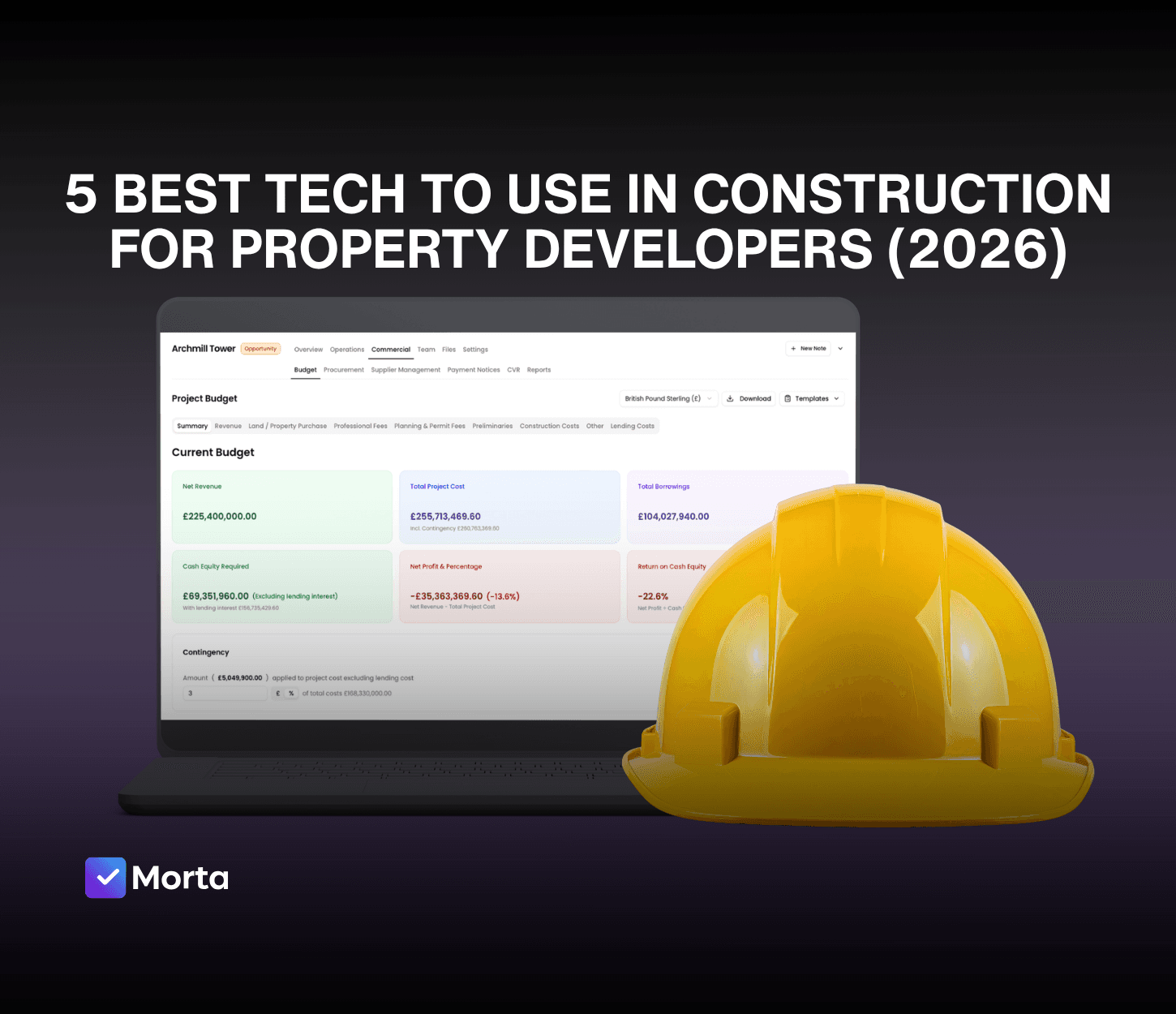
Morta takes the top spot because it is one of the few platforms that is clearly built as software for property development rather than generic construction software dressed up with a few developer-friendly labels.
That difference matters.
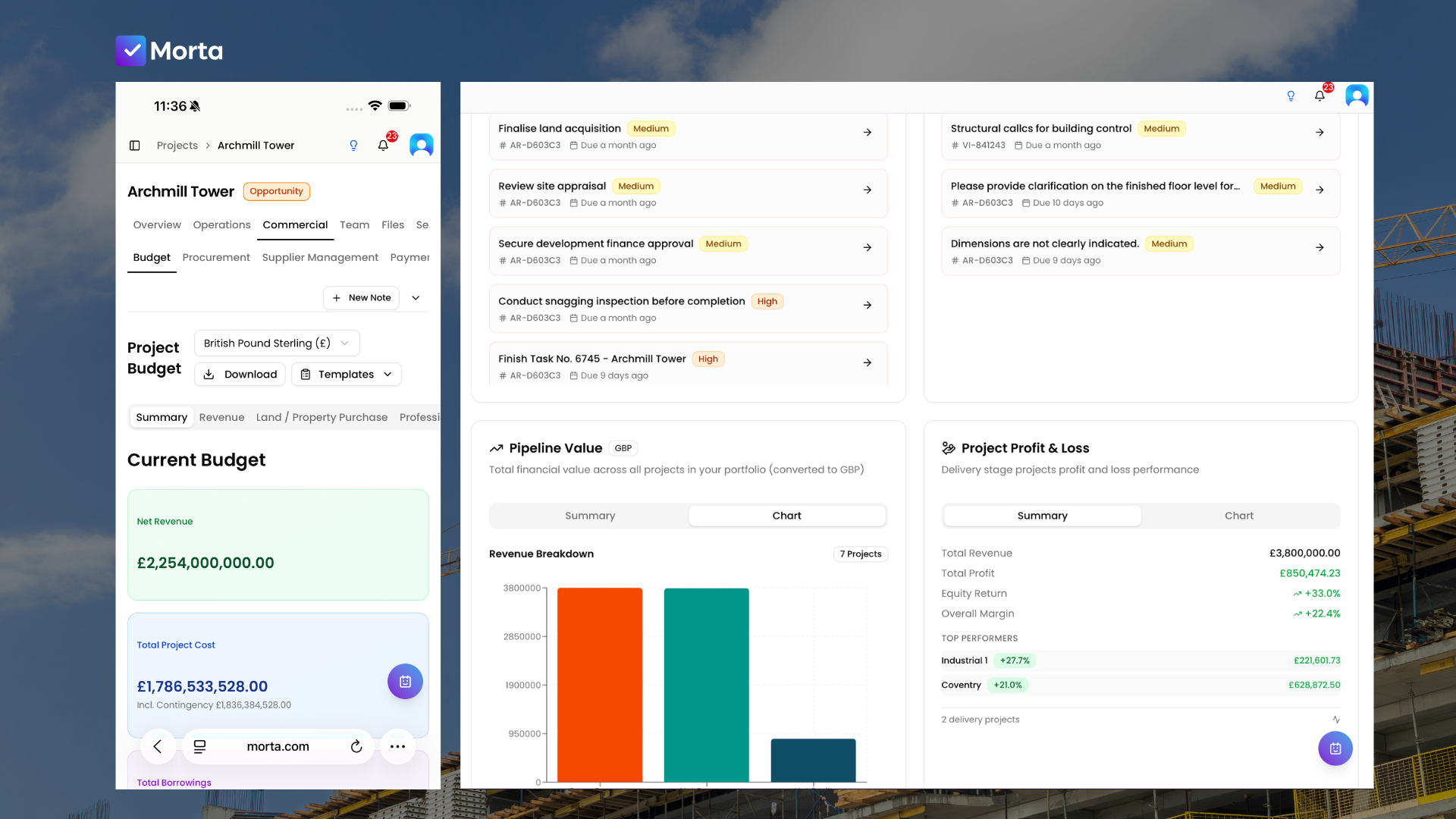
Morta positions itself as software for property developers that brings together CRM, planning, budgeting and reporting in one place. It also highlights dedicated capabilities across project planning, cost planning and reporting, project handover, and property development AI.
Its property development CRM is framed around tracking opportunities, sites and stakeholders alongside live project data, rather than acting as a standard contact database.
That gets to the heart of why it ranks first.
Most construction management software starts with delivery and works outward. Morta starts with the developer’s view of the project. That means the jump from early opportunity to live job is not treated like a baton pass between disconnected systems. It is one thread.
If you are an independent developer, this saves time in a very practical way. You stop rebuilding information every time a scheme gets more real. The appraisal becomes linked to live decisions. The opportunity pipeline does not sit in a separate world from planning activity. Cost planning is not buried in email attachments. Handover is not an afterthought once everyone is already tired of the job.
If you are a larger corporate developer, the appeal is slightly different. It is less about replacing one spreadsheet and more about creating consistent operating rhythm across projects. You get cleaner reporting, clearer ownership, fewer version-control problems, and a better route from director-level oversight to team-level action.
This is also where Morta feels more modern than many older platforms. Its AI positioning is not vague. Morta's property development AI is designed to analyse data, automate tasks and keep projects moving with less friction. That is a sensible use of AI in this sector. Nobody needs another novelty chatbot. What people need is faster appraisal work, quicker access to answers, less manual reporting, and fewer repeat admin tasks.
The other reason Morta stands out is that it does not force property developers to think like contractors. That sounds minor until you have used software that was clearly designed around subcontract packages and field reporting first, then stretched to cover development. Morta feels closer to how developers actually run a scheme, from pre-construction through development and delivery to post handover.
Procore is still one of the biggest names in construction tech for a reason. It is mature, broad, and battle-tested. On its own site, Procore describes itself as an end-to-end construction management solution covering preconstruction through closeout, with dedicated capabilities around project execution, cost management, lifecycle management and quality and safety. It also highlights usage across more than 3 million global projects. ProcorePreconstructionQuality & Safety
There is a lot to like here.
If your team needs strong construction management software for active delivery, Procore is hard to ignore. The field-to-office link is one of its biggest strengths. For businesses running complex jobsite activity, especially those with multiple contractors and a constant stream of site issues, the platform gives a level of operational structure that many teams find reassuring.
Its preconstruction side is also stronger than people sometimes assume. Procore talks about faster takeoffs, better bid accuracy and easier trade partner qualification, which makes it more than just a site execution platform. On the quality and safety side, it leans into inspections, observations, corrective actions and real-time tracking, which will appeal to teams where compliance and site controls are high on the priority list.
Procore can still feel like a contractor-first system. If your day-to-day concern is not only delivering the build, but also managing opportunity pipelines, early-stage decisions, commercial sign-off, and post-handover accountability from a developer’s perspective, you may find yourself needing adjacent tools to close the gaps.
That is really the theme of this ranking. Procore is excellent construction software. It is not the most developer-native option.
Still, it deserves second place because if your projects are large, your contractor ecosystem is substantial, and your team already thinks in delivery-led workflows, Procore remains one of the safest choices on the market.
Autodesk Construction Cloud sits in third because it is powerful, well-connected, and especially compelling for teams already deep in Autodesk workflows. On its official site, Autodesk positions the platform as a single source of truth across the project, with real-time insight into costs and schedules, lifecycle cost visibility for owners, and more than 400 pre-built integrations across ERP, CRM, document management and analytics tools. It also says the software is trusted on more than 2 million projects.
That gives you a clear sense of where it shines.
If your organisation lives close to BIM, design coordination and model-driven decision making, Autodesk has a natural advantage. For developers with technically demanding schemes, especially where designers, consultants and delivery teams need a tighter information loop, Autodesk Construction Cloud can provide structure without feeling entirely separate from the design environment.
It also has credibility with owners. Autodesk explicitly talks about helping owners manage construction lifecycle costs across portfolios using the latest BIM data. For corporate-level developers, that portfolio view can be attractive, particularly where reporting and long-term asset thinking matter.
Where it becomes less convincing is when the business problem is broader than coordination. If what you really need is software for property development that starts with opportunities, appraisals, approvals and developer reporting, Autodesk is not as naturally aligned as Morta. It is still strong construction management software, but it is not as tailored to the commercial and operational rhythm of development businesses.
That said, I would still rank it above many other platforms because it does not pretend to be lightweight. It knows what it is good at. If your team wants serious construction tech with design depth and enterprise-level connectivity, Autodesk is worth a proper look.
Aconex has a particular reputation in the industry, and it has earned it. Oracle presents Aconex as a platform for managing project lifecycle processes, connecting teams, and creating a complete project record through a unique data ownership model. It highlights an unalterable audit trail, a single document register, configurable workflows, tender management, mobile field access, test plans, inspections, supplier documentation management and project archiving.
That is a serious list, and for the right projects it is exactly what you want.
If you are operating in an environment where approvals need to be watertight, correspondence must be tracked properly, and disputes are a real commercial risk, Aconex is a strong option. It is particularly good at handling formal process. Many platforms talk about collaboration. Aconex is more interested in proving who approved what, when they approved it, and what changed afterwards. In some projects, that is more valuable than a slick dashboard.
Its handover and archive capability is also worth noting. Developers often discover too late that post-completion information is scattered across inboxes, folders and contractor systems. Aconex takes that side of the job seriously.
The trade-off is that it can feel heavy. For leaner development teams or businesses trying to move faster, not formalise every possible step, Aconex can be more system than they need. It is not trying to be friendly in the same way some newer platforms are. It is trying to be rigorous.
So fourth place feels fair. It is a very capable platform, but better suited to large, compliance-heavy environments than to every property developer shopping for day-to-day operating software.
Buildxact earns the fifth spot because it is highly practical, especially if your immediate pain point is estimating rather than full lifecycle development control.
On its site, Buildxact says it is designed for residential builders and covers takeoffs, estimating, quoting, scheduling and job tracking. It also leans heavily into its AI-supported Blu assistant, which includes estimate review, takeoff assistance, estimate generation and support for repeatable assemblies. It links estimating to dealer pricing, labour rates, markup and project management workflows.If your search is really for the best construction estimating software for smaller residential projects, Buildxact deserves attention. It is one of the clearer, more focused options in that part of the market. The takeoff and estimating workflows are easy to understand, and the practical connection to live pricing is helpful for margins.
It is also one of the few tools on this list that genuinely feels helpful for people moving up from smaller projects. If you are transitioning from property flipping into a more formal development model, or you are a builder-developer trying to get control of pricing and quotes, Buildxact can feel much less intimidating than a large enterprise platform.
The reason it sits fifth is not because it is weak. It is because it is narrower. This is construction estimating software first, broader development operating system second. If you need a platform that covers pipeline, approvals, cost visibility, collaboration, handover and defects in a developer-centric way, it will not go as far as Morta.
Still, for residential builders and estimator-led businesses, it is a good product and worth a fair mention.
What actually matters when choosing construction tech
Selecting the best software for your property development business is a big decision.
First, does it match your business model? A developer does not think like a subcontractor. You care about land opportunities, appraisals, planning risk, cost movement, commercial decisions and post-handover exposure, not just what happened on site this morning.
Second, does it reduce handoffs between teams? If your CRM lives in one place, your budget in another, defects in a third, and board reporting in spreadsheets, the software stack is working against you.
Third, can it handle the whole lifecycle, not just one stage? Plenty of tools are brilliant for estimating. Plenty are brilliant for site execution. Fewer are useful from early-stage planning through to handover.
Fourth, will the team actually use it? This sounds obvious, but it is where many software decisions fall apart. The best construction management software is not the one with the biggest feature list. It is the one people can understand without needing a three-month rescue project.